

Healthcare systems across the UK are facing a difficult balancing act.
Patient demand continues to grow, long-term conditions are becoming more common, hospital capacity remains under pressure, and healthcare organisations are expected to deliver high-quality care while improving efficiency.
Against this backdrop, virtual wards have emerged as an increasingly important part of modern healthcare delivery.
Rather than requiring every patient to remain in hospital, virtual wards enable suitable patients to receive monitoring, treatment, and support in their own homes while remaining under the supervision of healthcare professionals.
For many healthcare organisations, the concept itself is not new. The challenge is making it work effectively at scale.
Collecting patient data through connected devices is only one piece of the puzzle.
Healthcare teams also need reliable systems that can bring information together, support clinical workflows, integrate with existing infrastructure, and help clinicians identify patients who may require attention.
This is where virtual ward software plays a critical role. As part of broader Healthcare Software Development initiatives, these platforms help organisations manage remote care delivery, clinical workflows, and patient monitoring more effectively.
In this guide, we'll explore what virtual ward software is, why healthcare organisations are investing in it, the challenges that often emerge as programmes grow, and the technology considerations that can influence long-term success.
Key Takeaways
- Virtual wards allow suitable patients to receive hospital-level monitoring and support at home while remaining under clinical supervision.
- As virtual ward programmes grow, technology often becomes the biggest operational challenge rather than Remote Patient Monitoring itself.
- Interoperability, scalability, security, and workflow efficiency are critical considerations when developing virtual ward software.
- AI healthcare development can support clinical teams through alert prioritisation, workflow automation, and data analysis, but it should complement rather than replace clinical judgement.
- Healthcare organisations evaluating virtual ward technology should consider both immediate operational requirements and long-term scalability.
What Is Virtual Ward Software Development?
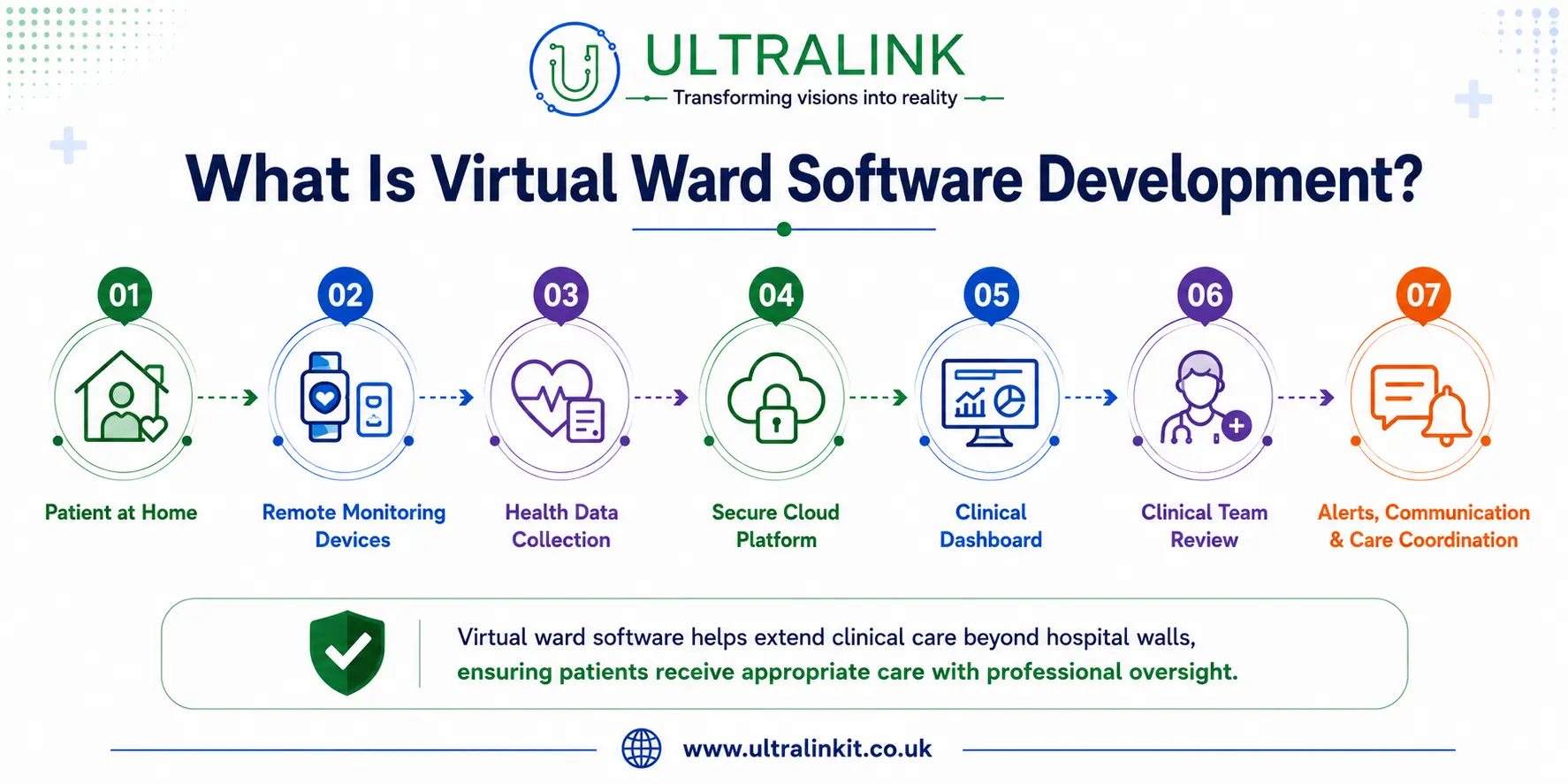
Virtual ward software development is a digital platform that helps healthcare organisations monitor and manage patients outside traditional hospital settings.
These healthcare software platforms are commonly used alongside Remote Patient Monitoring technologies that collect health information from patients at home. Depending on the care pathway, this may include:
- Blood pressure readings
- Heart rate measurements
- Oxygen saturation levels
- Respiratory rate data
- Blood glucose readings
- Activity and mobility information
- Symptom reporting
The software acts as the central hub where clinicians can review patient information, monitor progress, manage alerts, communicate with patients, and coordinate care activities.
While the technology itself is important, the objective is straightforward: enable patients to receive appropriate care in the most suitable setting while maintaining clinical oversight.
Virtual wards are now being used across a variety of clinical scenarios, including:
Chronic Disease Management
Patients living with conditions such as COPD, heart failure, and diabetes often require ongoing monitoring and support. Virtual wards can help healthcare teams maintain visibility while reducing the need for frequent in-person visits.
Post-Discharge Monitoring
Many patients require continued observation after leaving hospital. Virtual wards can provide an additional layer of oversight during recovery and help clinicians identify potential concerns earlier.
Frailty and Elderly Care
Older patients often benefit from receiving care in familiar surroundings. Remote monitoring can support healthcare professionals while helping reduce unnecessary hospital admissions.
Surgical Recovery
Patients recovering from planned procedures may be able to return home sooner while still remaining connected to clinical teams through digital monitoring and follow-up processes.
The common theme across all of these use cases is that technology helps extend clinical care beyond the walls of a hospital without removing professional oversight.
Why Are Virtual Wards Growing Across the NHS?
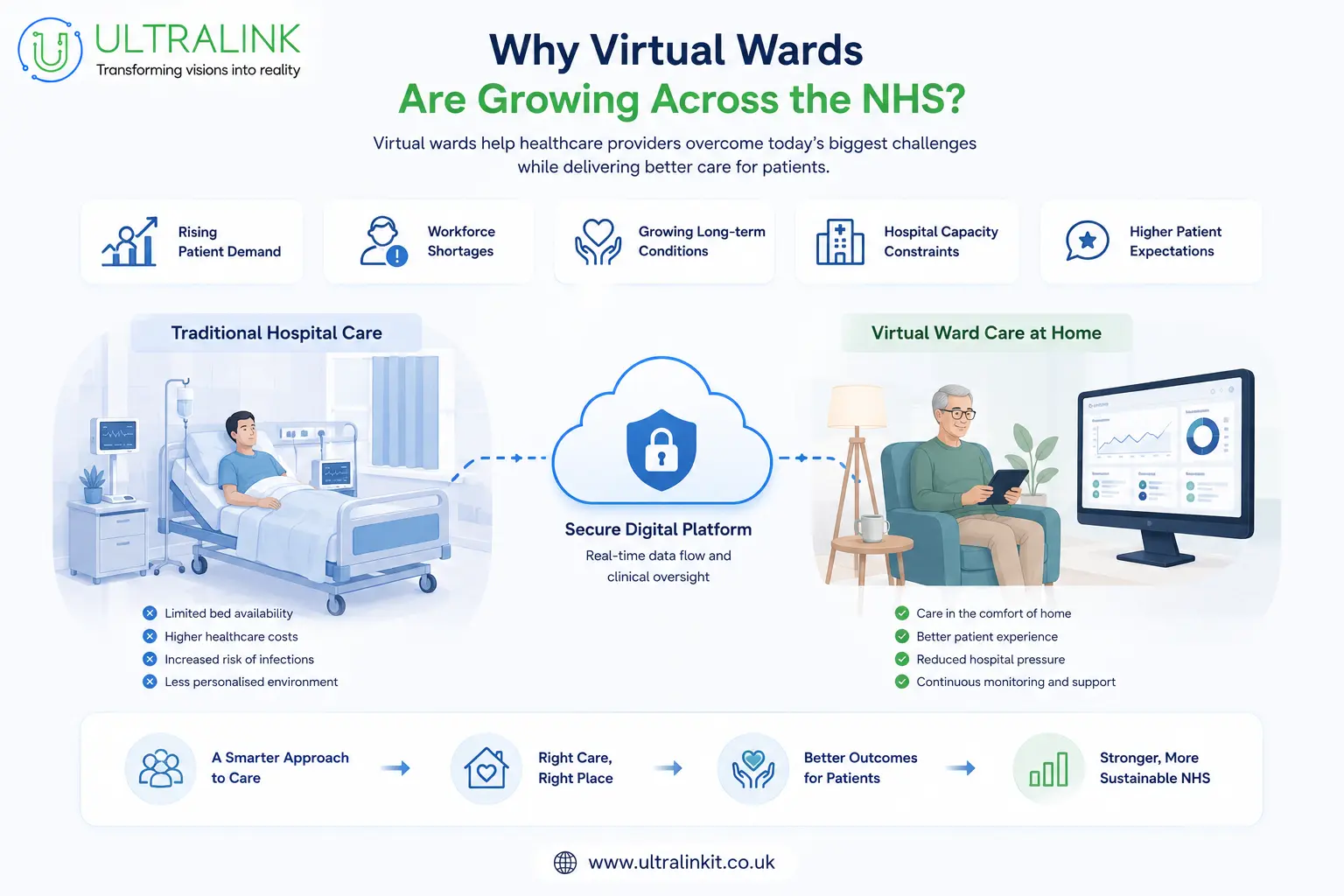
The increasing adoption of virtual wards is largely driven by practical healthcare challenges rather than technology trends.
Healthcare providers are under pressure to improve access to care while managing finite resources.
Many organisations are facing:
- Rising patient demand
- Workforce shortages
- Growing numbers of patients with long-term conditions
- Hospital capacity constraints
- Increased expectations around patient experience
Traditional models of care often require patients to remain in hospital for monitoring even when they are medically stable enough to be cared for elsewhere.
Virtual wards provide an alternative approach.
By combining Remote Patient Monitoring, clinical oversight, and digital healthcare technologies, healthcare organisations can support appropriate patients at home while maintaining visibility into their condition.
For patients, this may mean recovering in a more comfortable environment.
For healthcare providers, it may help create additional capacity while supporting more flexible models of care.
However, it's important to recognise that virtual wards are not simply a technology project.
Successful programmes depend on clinical processes, governance frameworks, patient suitability, operational workflows, and the technology that supports them.
Technology enables virtual wards, but it is only one component of a much broader care delivery model.
Common Challenges Healthcare Providers Face
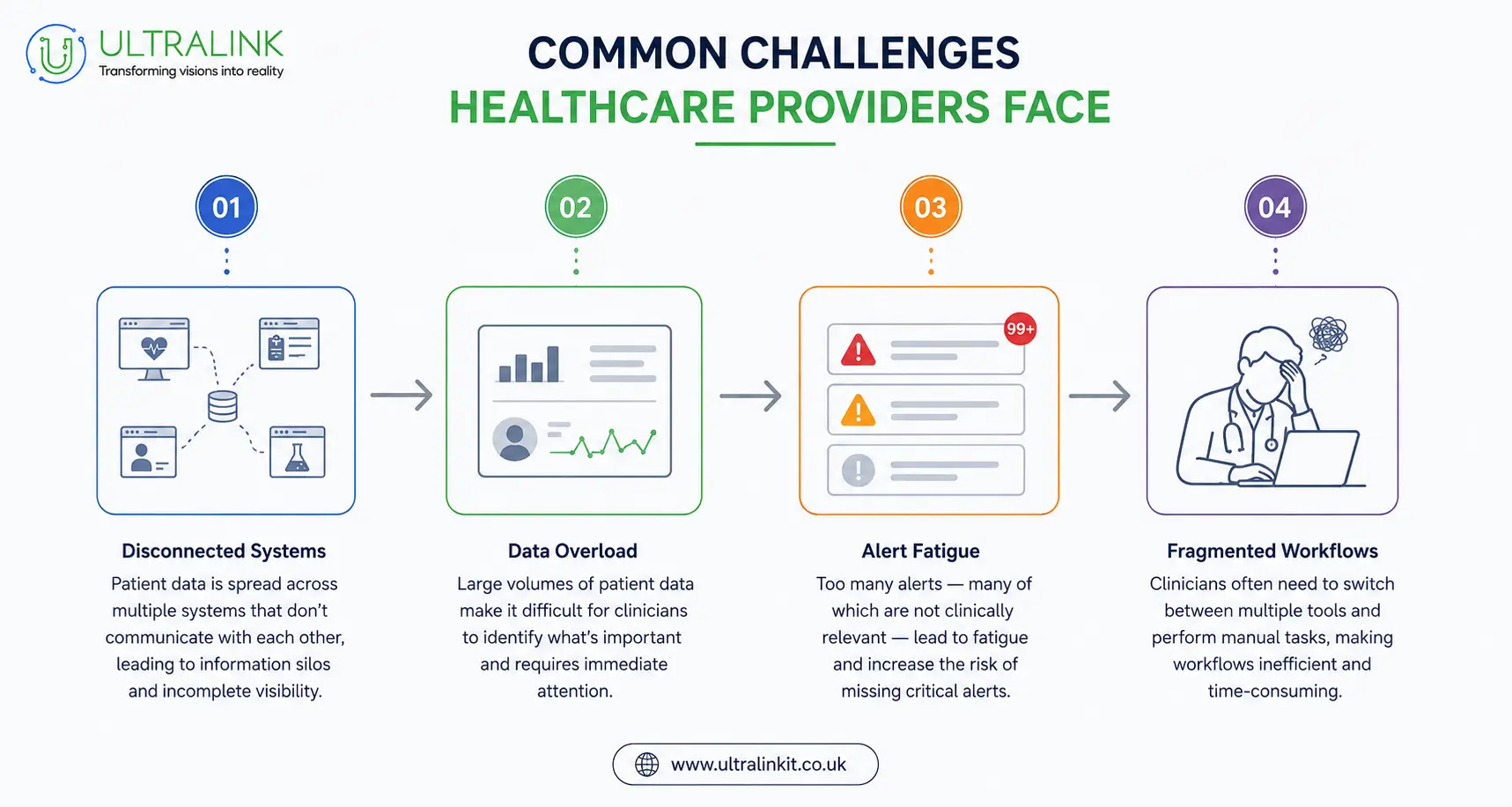
Launching a virtual ward programme is often easier than scaling one.
As virtual ward programmes expand, healthcare organisations often find that reporting requirements, workflow coordination, and integration needs become more sophisticated.
Several challenges appear repeatedly across virtual ward initiatives.
Alert Fatigue
Remote monitoring systems can generate large numbers of notifications every day.
When clinicians are required to review increasing volumes of alerts, identifying genuinely urgent cases can become more difficult. This can create additional workload and reduce operational efficiency.
Fragmented Systems
Patient information is frequently spread across multiple platforms.
Healthcare teams may need to move between electronic health records, telehealth applications, patient engagement tools, and monitoring systems simply to obtain a complete picture of patient care.
Manual Processes
Many programmes continue to rely on manual reviews, spreadsheets, and administrative processes.
While this may be manageable for smaller cohorts, it often becomes difficult to sustain as patient numbers increase.
Limited Visibility
Collecting patient data is valuable, but healthcare teams also need meaningful insights.
Without effective reporting, trend analysis, and prioritisation mechanisms, large volumes of information can become difficult to interpret.
Why Technology Often Becomes the Limiting Factor
One misconception about virtual wards is that success depends primarily on monitoring devices.
In reality, many of the biggest challenges emerge within the software ecosystem that sits behind those devices.
Consider a respiratory care programme supporting several hundred patients.
Even if each patient submits only a handful of readings per day, clinicians may still be reviewing thousands of individual data points every week.
The question is no longer whether data is available.
The question becomes:
- How quickly can clinicians identify the patients who genuinely need intervention?
- How easily can they access relevant information?
- How efficiently can they coordinate care activities?
As programmes expand, organisations often discover that technology designed for smaller deployments may struggle to support larger patient populations, more complex workflows, and growing reporting requirements.
This is why scalability, interoperability, workflow design, and user experience are increasingly important considerations when developing virtual ward software.
The most successful platforms are not necessarily the ones that collect the most data.
They are the ones that help healthcare professionals turn data into meaningful action.
The Role of AI in Virtual Ward Software
AI in Healthcare is becoming an increasingly common topic in healthcare technology discussions. However, when it comes to virtual wards, the most valuable use cases are often the most practical ones.
The goal of AI healthcare development is not to replace clinicians or automate clinical decision-making. Instead, it can help healthcare teams manage growing volumes of patient data more efficiently and identify situations that may require closer attention.
As virtual ward programmes expand, clinicians often find themselves reviewing hundreds or even thousands of patient readings every week. Without effective prioritisation, it becomes increasingly difficult to distinguish routine observations from potential signs of deterioration.
This is where AI-assisted capabilities may add value.
Intelligent Alert Prioritisation
One of the most common challenges in Remote Patient Monitoring is alert fatigue.
If every abnormal reading generates an alert, clinical teams can quickly become overwhelmed. AI-assisted systems may help categorise alerts based on risk indicators, enabling clinicians to focus their attention on patients who may require intervention sooner.
Trend Analysis and Risk Identification
A single reading rarely tells the full story.
For example, a slight increase in heart rate may not be clinically significant on its own.
However, when viewed alongside oxygen saturation levels, symptom reporting, activity data, and historical trends, it may provide additional context.
Some platforms use machine learning models to identify patterns that could indicate a change in patient condition. These insights can support clinical decision-making, although clinical judgement should always remain central to patient care.
Workflow Automation
Healthcare teams spend significant time on administrative activities that support patient care.
AI-assisted workflows may help automate:
- Follow-up reminders
- Appointment scheduling
- Escalation processes
- Documentation support
- Reporting activities
While these capabilities do not directly replace clinical work, they can help reduce administrative burden and improve operational efficiency.
The most effective AI implementations are often the least visible. Rather than trying to replace healthcare professionals, they support clinicians by helping them work more effectively with the information available.
Why Interoperability Matters More Than Most Organisations Expect
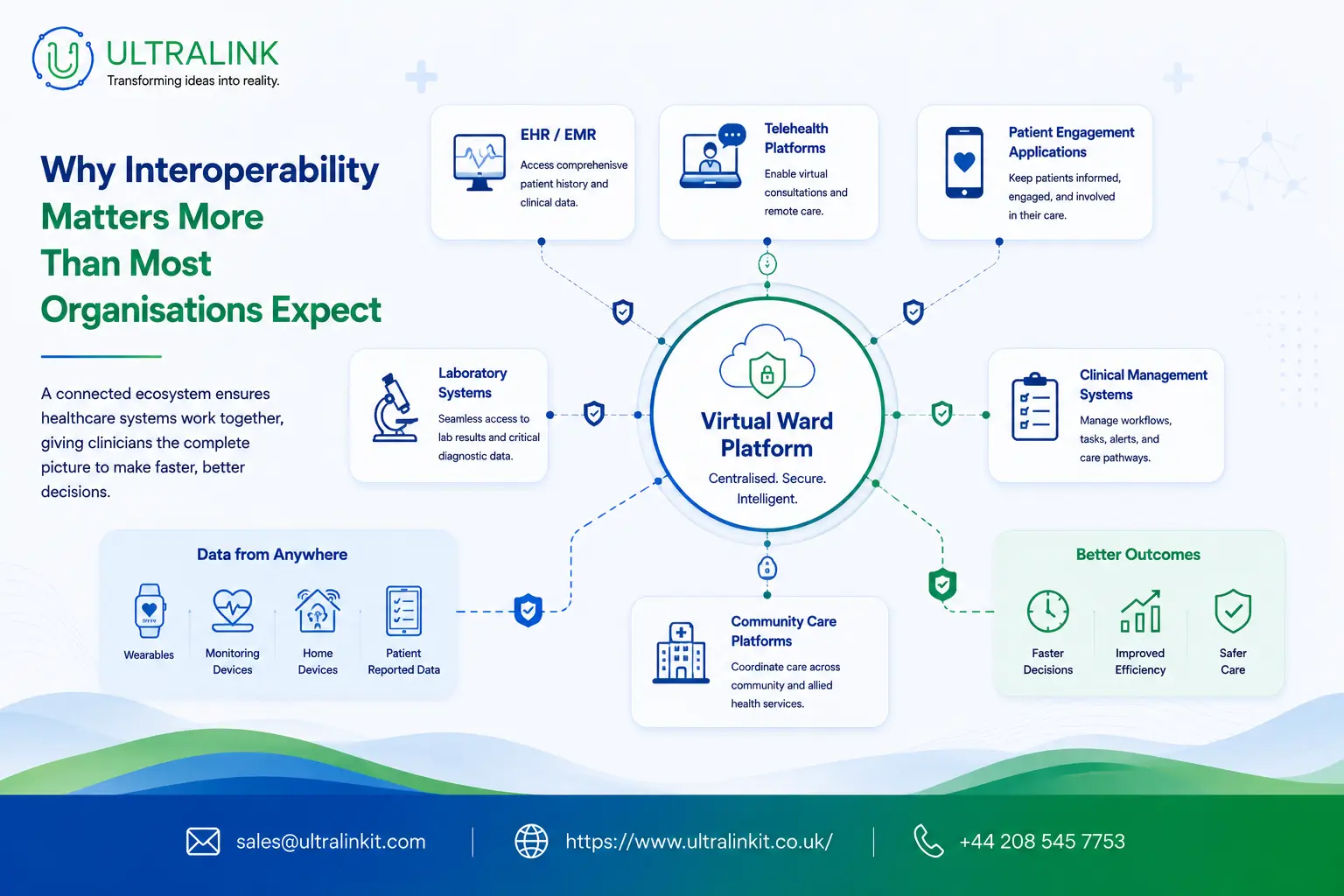
Many healthcare organisations initially focus on monitoring devices when planning a virtual ward programme.
The bigger challenge often emerges later.
Patient information rarely exists in a single system.
Healthcare teams may need to access:
- Electronic Health Records (EHRs)
- Electronic Medical Records (EMRs)
- Telehealth platforms
- Patient engagement applications
- Clinical management systems
- Laboratory systems
- Community care platforms
When these systems operate independently, clinicians are forced to switch between multiple applications simply to understand a patient's current situation.
This creates inefficiencies, increases administrative workload, and can delay decision-making.
For virtual wards to operate effectively, information needs to move securely and efficiently between systems.
Essential Features of Modern Virtual Ward Software
Every healthcare organisation has different requirements, but several capabilities consistently appear in successful virtual ward platforms.
Centralised Clinical Dashboard
Clinicians need a clear view of patient status without navigating multiple systems.
A centralised dashboard typically provides visibility into:
- Patient health data
- Risk indicators
- Active alerts
- Care pathways
- Escalation requirements
The objective is to help teams quickly understand which patients may require attention.
Remote Patient Monitoring Integration
The platform should support secure collection and management of data from approved monitoring devices and patient-reported outcomes.
This may include:
- Blood pressure monitoring
- Pulse oximetry
- Glucose monitoring
- Symptom reporting
- Activity tracking
Secure Communication Tools
Virtual wards rely on effective communication between patients and care teams.
Many organisations choose to incorporate:
- Secure messaging
- Virtual consultations
- Care updates
- Appointment management
These capabilities can help improve patient engagement while supporting ongoing clinical oversight.
Reporting and Operational Analytics
As programmes grow, healthcare leaders require visibility into both clinical and operational performance.
Meaningful reporting can support:
- Service evaluation
- Capacity planning
- Resource allocation
- Outcome measurement
- Programme optimisation
Scalable Architecture
Technology requirements rarely remain static.
A platform that supports 100 patients today may need to support 5,000 patients tomorrow.
Scalability should be considered from the beginning rather than addressed after growth has already occurred.
Build vs Buy: Which Approach Makes More Sense?
One of the most common questions healthcare organisations face is whether to purchase an off-the-shelf platform or invest in custom software development.
Organisations with specific integration requirements, unique care pathways, or long-term digital transformation objectives may find that custom software offers greater flexibility than standard platforms.
The answer depends on organisational objectives, existing infrastructure, and long-term requirements.
Off-the-Shelf Platforms
Pre-built solutions often provide:
- Faster deployment
- Lower initial investment
- Standardised functionality
- Vendor-managed updates
For organisations looking to launch a programme quickly, this can be an attractive option.
However, limitations may emerge as requirements become more specialised.
- Deployment — Off-the-Shelf: Faster | Custom: Longer
- Flexibility — Off-the-Shelf: Limited | Custom: High
- Integrations — Off-the-Shelf: Standard | Custom: Tailored
- Scalability — Off-the-Shelf: Vendor-defined | Custom: Requirement-driven
- Control — Off-the-Shelf: Limited | Custom: Greater
Custom Virtual Ward Software
Custom development allows organisations to design technology around their specific clinical and operational workflows.
Potential advantages include:
- Tailored user experiences
- Custom integrations
- Greater scalability
- More control over future development
- Alignment with existing care pathways
For healthcare organisations with complex integration requirements or long-term digital transformation strategies, custom development may provide greater flexibility.
The decision is rarely about which option is universally better.
The real question is which approach aligns best with organisational goals, clinical requirements, and future plans.
Security, Compliance and NHS Readiness
Virtual ward platforms manage highly sensitive patient information.
As a result, security and compliance cannot be treated as secondary considerations.
Healthcare organisations should evaluate technology solutions against relevant regulatory, governance, and information security requirements.
Key considerations often include:
- UK GDPR compliance
- Data encryption
- Role-based access controls
- Multi-factor authentication
- Audit logging
- Secure cloud infrastructure
- Business continuity planning
- Cybersecurity best practices
For organisations working within NHS environments, additional considerations may include:
- Data Security and Protection Toolkit (DSPT) requirements
- DCB0129 compliance considerations
- DCB0160 compliance considerations
- NHS interoperability standards
- Clinical safety processes
Security is not simply a technical requirement.
It plays a direct role in protecting patient trust, supporting governance obligations, and ensuring long-term sustainability.
When Does Custom Virtual Ward Software Make Sense?
Not every healthcare organisation needs a bespoke platform.
However, there are situations where custom healthcare software development becomes increasingly difficult to ignore.
These often include:
- Multiple disconnected systems
- Complex clinical workflows
- Unique reporting requirements
- Long-term scalability objectives
- Extensive interoperability needs
- Specific governance or security requirements
In these scenarios, forcing clinical teams to adapt to software limitations can create inefficiencies that persist for years.
Custom software allows technology to be designed around operational objectives rather than the other way around.
At Ultralink, we often see healthcare organisations reach a point where existing solutions no longer support future ambitions. The conversation then shifts from "Can the platform do this today?" to "Will the platform support where we want to be three years from now?"
That distinction often influences technology decisions far more than feature comparisons alone.
Looking Ahead: The Future of Virtual Care
Virtual wards are likely to remain an important part of healthcare delivery as organisations continue exploring new ways to improve access, efficiency, and patient outcomes.
Advances in Remote Patient Monitoring, wearable technologies, interoperability standards, and AI-assisted workflows are creating new opportunities for healthcare providers to deliver care beyond traditional settings.
Technology alone will not solve every healthcare challenge.
However, organisations that invest in scalable, secure, and interoperable digital foundations will be better positioned to adapt as care models continue to evolve.
The most successful virtual ward programmes are rarely defined by technology alone.
They are defined by how effectively technology supports clinicians, empowers patients, and enables better care delivery at scale.
How Ultralink Can Support Your Virtual Ward Strategy
At Ultralink, we work with healthcare teams to turn virtual ward and Remote Patient Monitoring ideas into practical digital solutions that actually work in day-to-day care.
Whether you're starting a new virtual ward programme, improving existing systems, or exploring how Remote Patient Monitoring could fit into your services, we can help you think through the best way forward for your setup.
Most teams we speak to are not just looking for software - they're looking for clarity on what will work in practice, what can scale, and how it will fit into existing workflows.
If you're in that stage, we're always happy to have a conversation and help you explore your options. If you'd like to discuss your requirements further, feel free to contact our team.