
Your clinic or healthcare organisation may provide an excellent service. But when someone searches for that service, can they find you and does your website give them enough confidence to take the next step?
SEO for the healthcare industry is the process of improving a healthcare organisation’s visibility across search engines and AI-assisted search experiences. It brings together technical optimisation, useful content, local visibility, evidence of expertise and a clear enquiry journey.
For healthcare providers, however, SEO cannot focus on rankings alone. Information must be accurate, marketing claims must be responsible, and the website must help visitors make informed decisions without creating unrealistic expectations.
This guide explains the practical foundations of healthcare SEO for UK clinics and providers and how to turn relevant search visibility into meaningful enquiries.
Why Does SEO Matter for UK Healthcare Providers?
Search is still central to how people find information and services. The UK Government’s DSIT Public Engagement Survey 2025/26 found that 97% of UK internet users had used a search engine to look something up, making it the most common digital task measured. The research included responses collected up to March 2026.
For a healthcare organisation, this search activity may include:
- Researching a symptom, condition or treatment
- Looking for a nearby clinic or specialist
- Comparing providers and services
- Checking qualifications, reviews and pricing
- Researching healthcare software or professional services
- Looking for a pharmaceutical, MedTech or healthcare partner
Demand can also change quickly. In June 2026, NHS England reported that visits to its hay fever advice page rose by 131% in one week, from 5,632 to 12,990 visits over comparable four-day periods.
This illustrates why healthcare organisations need both dependable evergreen content and the ability to respond to seasonal or emerging search demand.
SEO cannot guarantee rankings or enquiries. It can, however, make it easier for the right audience to find useful information at the point they are actively researching a need.
What Makes Healthcare SEO Different?
Healthcare SEO uses many of the same foundations as conventional SEO, but the standard of care required when creating content is higher.
Accuracy can influence real decisions
Healthcare content can affect how someone understands a symptom, treatment, medicine or service. Poorly researched content is therefore more than a marketing weakness it can mislead the reader.
Important healthcare pages should clearly show:
- Who wrote the information
- Whether it was reviewed by a qualified professional
- When it was last reviewed
- Which sources support important claims
- Who is responsible for the website
Google recommends creating reliable, people-first content and making the “Who, How and Why” behind it clear.
Clinical content should reference appropriate UK sources, such as the NHS, NICE, MHRA or relevant professional bodies. A healthcare marketer can structure and optimise the content, but should not replace qualified clinical review.
Healthcare marketing claims require care
Claims about treatments, outcomes, medicines and medical devices may be subject to UK advertising rules. Section 12 of the CAP Code covers marketing communications for medicines, medical devices, treatments and other health-related products.
Terms such as “guaranteed”, “completely safe”, “best treatment” or “permanent cure” should not be used without appropriate justification and in some contexts may not be acceptable at all.
SEO does not make a claim compliant. Regulatory, clinical and legal review must remain part of the publishing process.
Healthcare websites may collect sensitive information
Appointment forms, enquiry pages, analytics platforms and advertising tools can collect personal information. Healthcare organisations should understand what is collected, why it is required, how long it is retained and who can access it.
General marketing forms should not encourage visitors to submit unnecessary medical details. Privacy information and consent choices should be clear and informed by content ICO guidance.
How Do People Search for Healthcare Services?
Not every healthcare search has the same purpose. Understanding intent helps determine which pages your website needs.
| Search intent | Example | Suitable destination |
|---|---|---|
| Information | “What causes persistent knee pain?” | Clinically reviewed information page |
| Service research | “Private MRI scan” | Detailed service page |
| Local search | “Dermatologist near me” | Clinic or location page |
| Cost research | “Private GP consultation cost” | Service and pricing page |
| Provider research | “[Clinic name] reviews” | Accurate profiles and trust information |
| B2B research | “Healthcare software provider UK” | Sector-specific solution page |
A high-volume keyword is not automatically valuable. It must be relevant to the organisation’s services and match a need that the website can genuinely satisfy.
For example, a private dermatology clinic may gain more value from a smaller number of searches for a particular treatment in its service area than from thousands of broad searches about general skin health.
The goal is not to attract everyone. It is to reach people whose needs align with the information, services or solutions the organisation can provide.
What Should a Healthcare SEO Strategy Include?
A practical healthcare SEO strategy needs seven connected elements.
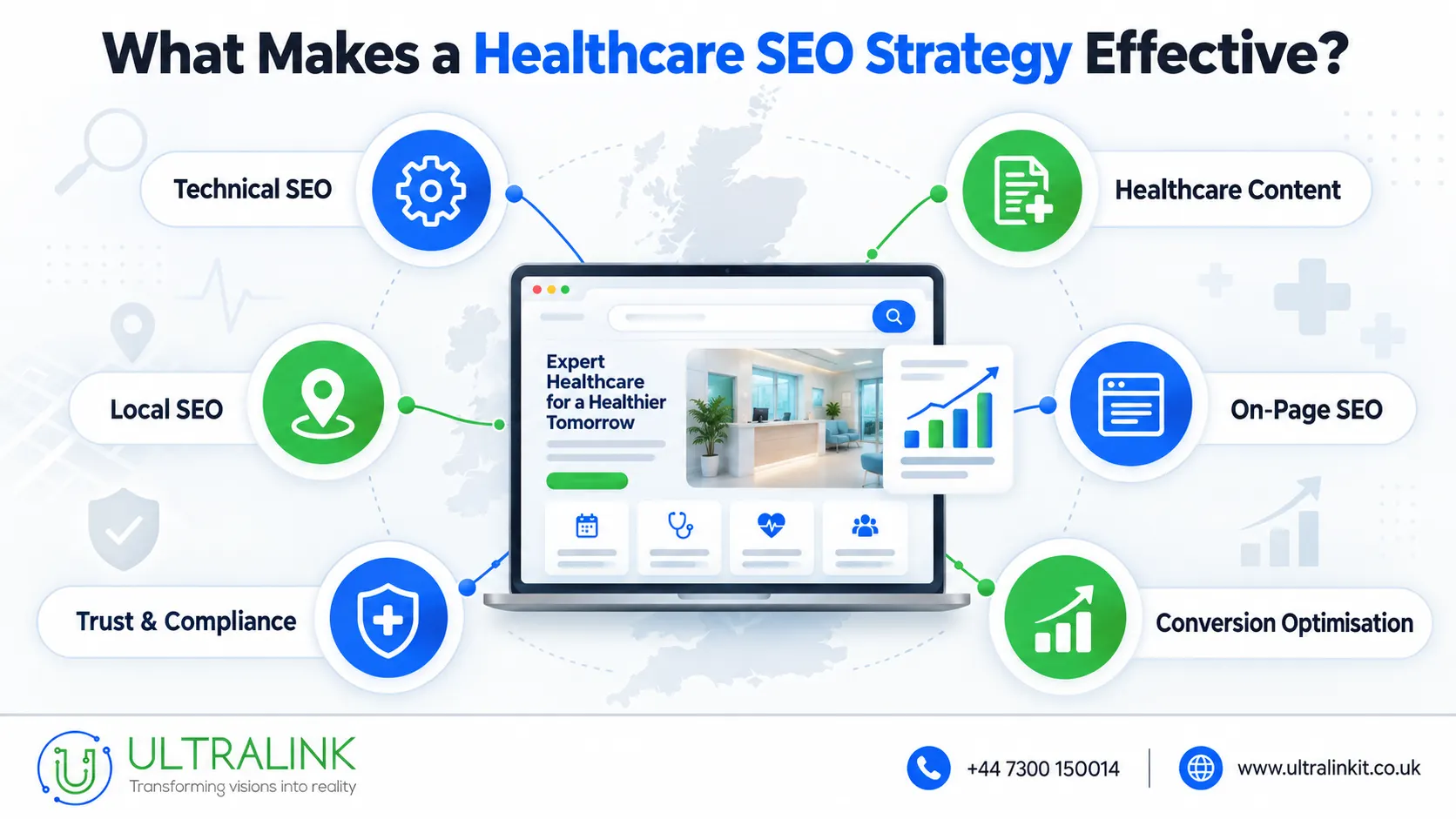
1. Search-intent and keyword research
Keyword research should identify how different audiences describe their needs. Patients may use everyday language, while clinicians and healthcare decision-makers may use more technical terms.
Research should cover:
- Conditions, treatments and specialities
- Clinic and service locations
- Pricing and eligibility questions
- Patient terminology and clinical terminology
- Referral or consultation queries
- Pharmaceutical, MedTech and HealthTech searches
- Questions asked during the decision-making process
Each important page should have one clear purpose. Trying to make every page rank for every related phrase usually creates vague and repetitive content.
2. Useful service and treatment pages
A healthcare service page should do more than describe a treatment in a few paragraphs. It should help the visitor understand whether the service may be relevant and what happens next.
Where appropriate, explain:
- Who the service is intended for
- What the service involves
- Who provides it
- Where it is available
- How an appointment or assessment works
- Potential limitations or eligibility requirements
- How pricing is determined
- How to enquire or book
The page should provide information, not diagnose the reader or imply that a particular treatment is suitable for everyone.
3. Clinically credible content
Blogs and guides should answer genuine questions that cannot be answered properly on a short service page.
Before publishing, ask:
- Does the content answer a real reader question?
- Is every medical statement supportable?
- Does it reflect UK terminology and pathways?
- Has an appropriate professional reviewed it?
- Is the author or reviewer identified?
- Will the information require future updates?
Avoid publishing large quantities of generic AI-generated health content. AI can assist with research organisation or drafting, but it should not invent evidence, patient outcomes or professional opinions.
Quality, usefulness and accountability matter more than publishing frequency.
4. Local SEO for clinics
For location-based providers, local visibility can connect searches with a genuine nearby service.
Important elements include:
- A complete and accurate Google Business Profile
- Consistent clinic name, address and telephone details
- Correct opening hours and service categories
- Individual pages for genuine clinic locations
- Directions, parking, public transport and accessibility information
- Accurate photographs
- A responsible process for requesting and responding to reviews
Avoid creating multiple thin pages for towns where the organisation has no clinic, practitioner or genuine service presence.
5. Technical SEO and accessibility
Useful content may still underperform if search engines cannot access it or visitors struggle to use the website.
Review:
- Mobile usability
- HTTPS and website security
- Page speed and Core Web Vitals
- Navigation and internal links
- Indexing and crawl controls
- XML sitemaps
- Duplicate pages and canonical tags
- Descriptive page titles and headings
- Image alternative text
- Accessible forms and keyboard navigation
- Broken links and outdated redirects
Google advises site owners to consider the overall page experience rather than concentrating on one technical score.
Accessibility also has a direct human value. Patients may use screen readers, keyboard navigation, magnification or mobile devices to access essential information.
6. Visible trust signals
Visitors should not have to investigate who is responsible for a healthcare website.
Relevant trust information may include:
- Clinician names and qualifications
- Professional registration details
- Clear company and clinic information
- Genuine accreditations
- Editorial and clinical-review processes
- Current contact information
- Pricing or an explanation of costs
- Privacy and cookie information
- Content review dates
- Sources supporting important claims
These elements should be accurate and verifiable. Do not display regulatory logos or accreditations unless the organisation is entitled to use them.
7. AI-search readiness
People are increasingly using generative AI alongside conventional search. The DSIT survey found that 59% of UK adults had used generative AI in the previous three months, rising to at least 75% among adults below 45.
Healthcare content can be made easier for search and AI systems to interpret by:
- Answering the main question early
- Using clear, descriptive headings
- Defining clinical or technical terminology
- Keeping organisational information consistent
- Citing reliable primary sources
- Identifying authors and reviewers
- Structuring information into concise paragraphs, lists and tables
- Adding accurate structured data that reflects visible content
No agency can guarantee that a healthcare organisation will be cited by Google AI Overviews, ChatGPT, Gemini or another answer platform. The sensible approach is to publish information that is clear, original, verifiable and genuinely useful.
How Can Healthcare SEO Generate Better Enquiries?
A ranking can create visibility, but the website must still help the visitor decide what to do.
A potential patient or decision-maker should be able to understand:
- Whether the organisation serves their need
- Who provides the service
- Where the service is available
- What the next step involves
- How to ask a question
- What will happen after submitting an enquiry
Use clear calls to action such as:
- Request an appointment
- Ask about eligibility
- Discuss your organisation’s requirements
- Speak with our team
- Request a website or SEO review
Avoid placing aggressive booking messages on sensitive health-information pages. The call to action should match the context and allow the reader to make an informed choice.
Forms should be short, mobile-friendly and limited to information genuinely required at that stage. After submission, explain when and how the organisation will respond.
If your website receives visits but very few relevant enquiries, the problem may not be traffic. It may be unclear service information, weak trust signals, poor mobile usability or an unnecessarily complicated enquiry process.
How Should Healthcare Organisations Measure SEO?
Rankings provide useful context, but they should not be the only measure.
A practical reporting framework should follow the full journey:
| Stage | What to measure |
|---|---|
| Visibility | Relevant impressions, non-branded searches and local visibility |
| Traffic | Organic clicks and visits to priority pages |
| Engagement | Service-page journeys and meaningful interactions |
| Enquiries | Calls, forms, bookings and consultation requests |
| Quality | Relevant versus unsuitable enquiries |
| Business impact | Qualified opportunities and attributable revenue where measurable |
| Content governance | Outdated pages, clinical reviews and corrections |
Branded and non-branded search should be reviewed separately. Someone searching for the organisation by name already knows it; someone discovering it through a treatment, service or problem-based query represents a different stage of awareness.
Be careful not to double-count actions. For example, a form submission that is also recorded as a session conversion should not be reported as two separate leads.
What Healthcare SEO Mistakes Should You Avoid?
Common problems include:
- Publishing medical content without suitable review
- Targeting keywords unrelated to available services
- Copying the same content across several location pages
- Using unsupported treatment or outcome claims
- Hiding author and reviewer information
- Leaving outdated guidance online
- Writing for search engines instead of readers
- Treating reviews as a keyword-placement exercise
- Ignoring mobile usability and accessibility
- Measuring performance only through rankings
- Expecting immediate or guaranteed results
Another frequent mistake is using the same page to target informational and commercial intent. A guide explaining a condition and a page offering a consultation have different jobs. They can support one another through internal linking, but they should not be forced into one repetitive page.
Should You Manage Healthcare SEO Internally or Use an Agency?
An internal approach may work when your organisation has:
- SEO and content expertise
- Development support
- Access to qualified reviewers
- A clear publishing and approval process
- Time to monitor performance and maintain content
External support may be useful when:
- Organic visibility is declining
- Technical issues remain unresolved
- Several clinic locations need to be managed
- Content is being published without consistent governance
- Tracking does not show which activity generates enquiries
- Your team needs support with search and AI visibility
Before appointing a provider, ask how it approaches healthcare accuracy, UK advertising requirements, technical implementation, reporting and clinical review. Be cautious of guaranteed rankings, fixed traffic promises or agencies that cannot explain how their work connects to qualified enquiries.
Building Healthcare Visibility Around Trust
Effective healthcare SEO begins with a simple question: what does the reader need to understand before taking the next appropriate step?
The answer may require a technically sound website, a clearer service page, a clinically reviewed guide, better local information or a more straightforward enquiry journey. Rankings matter, but only when they connect the right audience with information they can understand and trust.
At Ultralink, we provide healthcare SEO services for UK clinics, healthcare providers, pharmaceutical organisations and HealthTech businesses. We connect keyword research, content planning, technical SEO, analytics and AI-search readiness around the outcomes your organisation needs to achieve.
Is Your Healthcare Website Reaching the Right Audience?
We can review your current visibility, website structure and content to identify where relevant search demand is being missed and where the enquiry journey can be improved.