
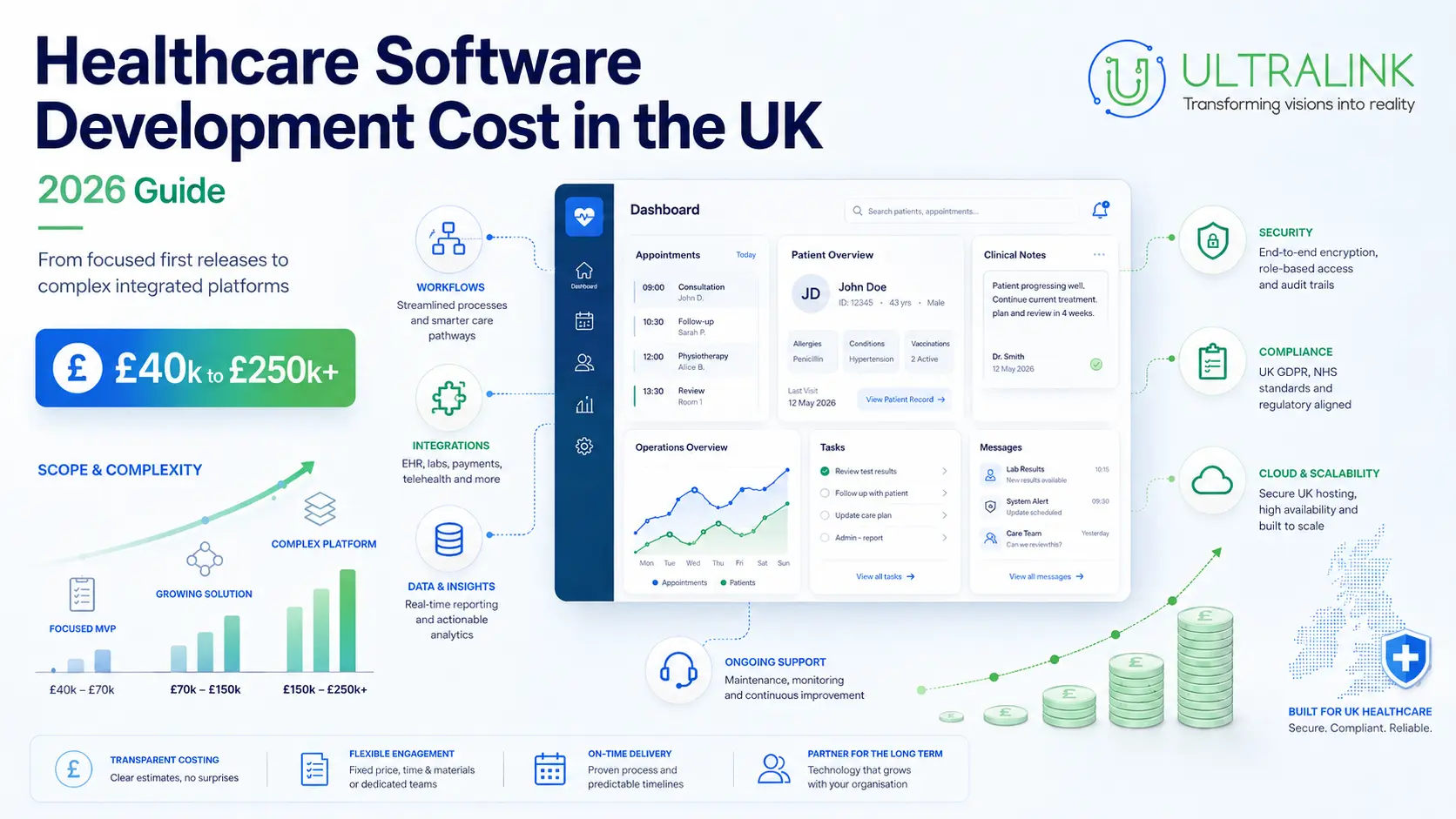
Custom healthcare software development in the UK can range from approximately £40,000 for a focused first release to more than £250,000 for a complex, integrated platform. Discovery and functional prototyping may require a smaller initial investment, while enterprise, multi-organisation or clinically complex systems normally need an individual assessment.
The final cost depends on more than the number of screens or features. User roles, workflow complexity, integrations, data requirements, clinical risk, security, assurance and long-term support can all materially affect the budget.
This guide explains the factors that influence custom healthcare software development costs, where the budget goes and what a development company needs to provide a reliable project estimate.
Pricing note: The figures below are broad planning estimates for custom healthcare software projects in the UK. They are not fixed Ultralink prices or quotations. Actual costs and delivery timelines depend on the project’s requirements, integrations, data, technical complexity, assurance needs and delivery model. Estimates exclude VAT, third-party licences and independent regulatory or assurance fees unless stated otherwise.
Indicative Custom Healthcare Software Development Costs in the UK
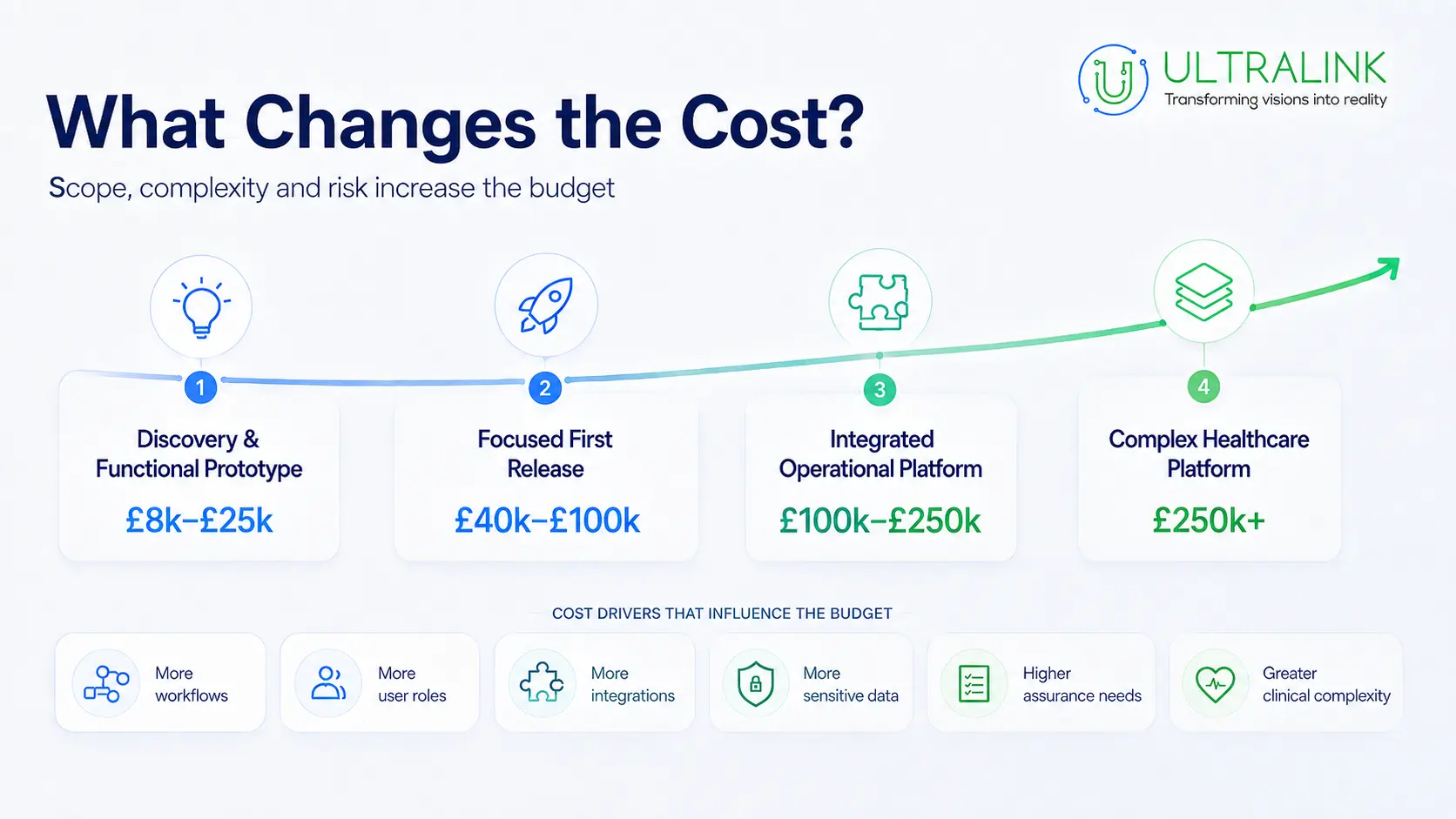
Healthcare software can describe anything from a focused administrative application to a multi-organisation clinical platform. It is therefore more useful to assess the project by its scope, technical complexity and risk than by its label alone.
| Project type | Typical scope | Broad planning range |
|---|---|---|
| Discovery and functional prototype | Requirements, workflow mapping, architecture and a testable prototype | £8,000–£25,000 |
| Focused first release | One primary workflow, limited user roles and few integrations | £40,000–£100,000 |
| Integrated operational platform | Multiple workflows, permissions, reporting and system integrations | £100,000–£250,000 |
| Complex healthcare platform | Clinical functionality, extensive integrations or multi-organisation deployment | £250,000+ |
These ranges illustrate how project scope can affect the level of investment. A project may fall outside them depending on its intended use, delivery model, technical dependencies and assurance requirements. Ultralink provides a project-specific estimate only after reviewing the requirements.
Two applications can look nearly identical while requiring substantially different levels of work. A portal that collects administrative information and sends it to an internal team is different from software that exchanges information with an electronic patient record or influences a clinical decision.
The Software You Are Building Sets the Starting Budget
The type of product helps establish the initial scope, but the functionality behind it determines the final cost.
| Healthcare solution | Common scope | Main cost variables |
|---|---|---|
| Patient portal | Registration, appointments, forms, results and secure messaging | Identity, accessibility, payments and EPR connectivity |
| Healthcare web application | Operational workflows, dashboards, reporting and document management | User roles, workflow rules and third-party systems |
| Mobile healthcare app | Patient or workforce functionality on iOS and Android | Offline access, device functions, notifications and platform choice |
| Pharmaceutical platform | Orders, inventory, verification, compliance records and audit trails | ERP, WMS, supplier and regulatory-data integrations |
| HealthTech SaaS platform | A product used by multiple healthcare organisations | Tenant separation, configuration, subscriptions and scalability |
| Clinical software | Functionality that supports or influences clinical decisions | Clinical safety, validation, evidence and potential medical-device classification |
A straightforward appointment application will not require the same investment as a multi-site patient platform connected to several clinical and operational systems. A reliable estimate must therefore begin with the problem, intended use and deployment environment.
Seven Decisions That Change Healthcare Software Development Cost
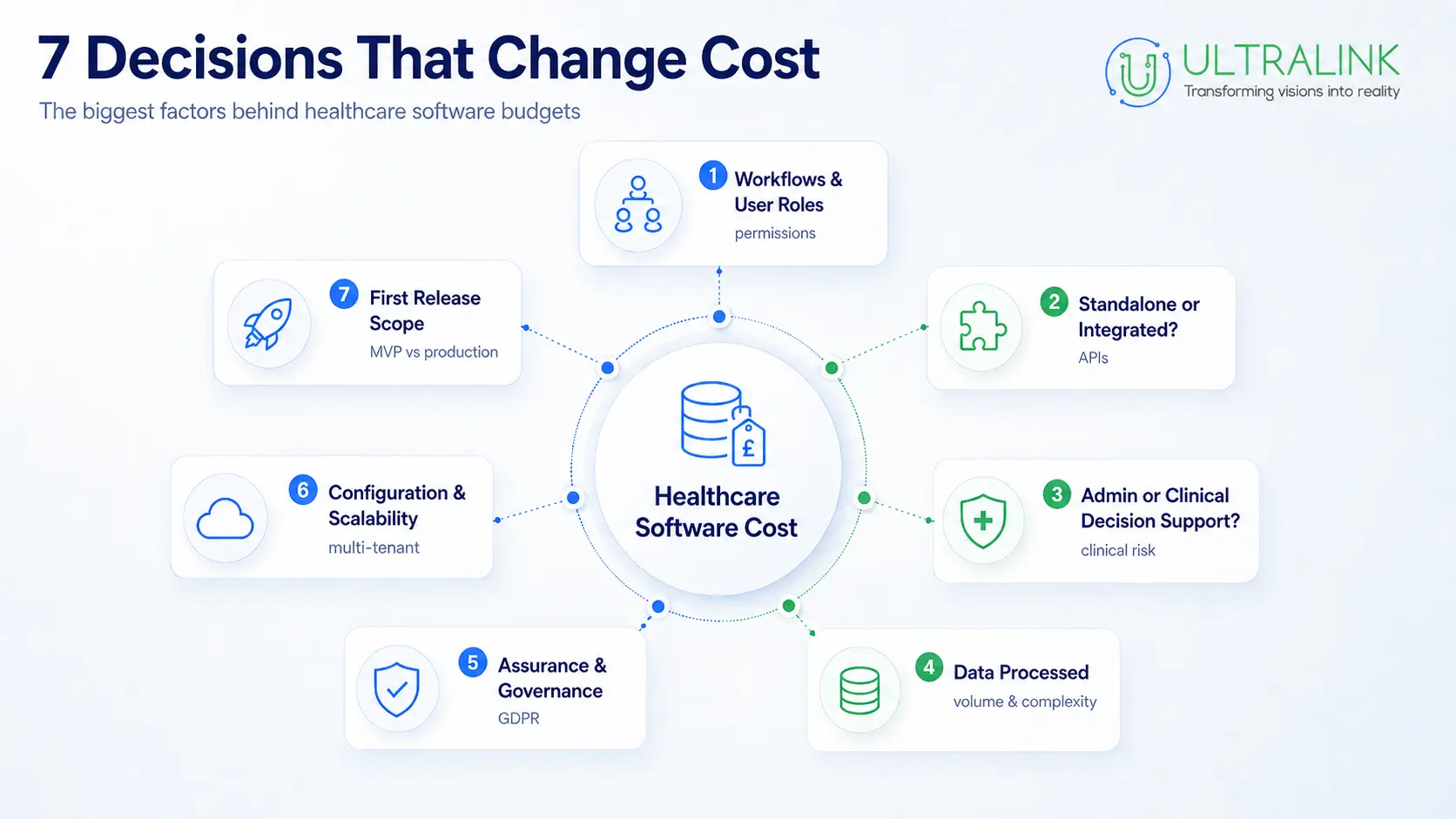
Most differences between healthcare software estimates can be traced to seven areas.
1. How Many Workflows and User Roles Are Required?
A system used by one internal team will usually be less complex than a platform serving patients, clinicians, administrators, managers and external partners.
Each role may require different:
- Permissions and access controls
- Dashboards and interfaces
- Notifications
- Approval routes
- Reporting capabilities
- Data visibility
- Acceptance testing
The important question is not simply how many people will use the software. It is how differently those people need to interact with it.
Cost can also increase when workflows contain numerous exceptions. A fixed five-step process is easier to design and test than one that changes according to the patient, service, location, professional role or clinical status.
2. Is the Software Standalone or Integrated?
Integrations are frequently underestimated during early budgeting.
A standalone application may only require its own database and selected third-party services. An integrated healthcare platform might need to communicate with an EPR, patient administration system, CRM, ERP, laboratory platform, payment provider or regulatory-data source.
Not all integrations require the same effort:
- Importing a scheduled file differs from exchanging information in real time.
- Reading information from another system differs from writing information back to it.
- Connecting to a documented API differs from working with a legacy system with limited technical documentation.
- Supporting one system differs from integrating with different platforms across multiple customer organisations.
A requirement such as “integrate with our EPR” is not detailed enough for dependable pricing. The development team needs to understand which system is involved, what information must move, in which direction, how frequently and what should happen when the connection fails.
HL7 or FHIR can support healthcare interoperability, but using a recognised standard does not remove the need for data mapping, authentication, error handling, testing and coordination with the other system’s provider.
3. Does the Software Support Administration or Influence Clinical Decisions?
The intended purpose of the software can materially change the delivery and assurance requirements.
An application that routes administrative documents or coordinates appointments normally presents a different risk profile from software that:
- Provides diagnostic recommendations
- Calculates clinical risk
- Suggests a course of treatment
- Controls or influences a medical device
- Prioritises patients using clinical information
Certain software may meet the definition of a medical device. When this is possible, its intended purpose and regulatory position should be assessed early. Introducing the necessary evidence, risk management and technical documentation after development has started can require substantial additional work.
Not every healthcare application is a medical device. Classification depends on the software’s intended purpose and functionality, not merely on the fact that it is used in healthcare.
Organisations should refer to current MHRA guidance on medical-device software and seek appropriate specialist advice for the specific product.
4. What Data Will the Software Process?
Software handling health information needs controls around confidentiality, access, retention and accountability.
The project budget may be affected by:
- The volume and sensitivity of the data
- The number of data sources
- Lawful basis and special-category conditions
- Consent requirements where applicable
- Role-based access
- Encryption
- Audit records
- Retention and deletion rules
- Data residency requirements
- Anonymisation or pseudonymisation
- Migration from existing systems
- Data quality and duplication
Data migration deserves particular attention. Moving clean, consistent information from one modern platform may be relatively straightforward. Migrating years of inconsistent records from spreadsheets, legacy databases and disconnected systems may require substantial data assessment, cleansing, mapping and validation.
A Data Protection Impact Assessment may be required where processing is likely to result in a high risk to individuals. Data-protection requirements should be considered during discovery and design, rather than being treated as a final check before launch.
The Information Commissioner’s Office provides current guidance on when and how to conduct a DPIA.
5. Which Assurance and Governance Requirements Apply?
The applicable requirements depend on the product, its intended users, the organisations purchasing it and the environment in which it will operate.
Depending on the project, relevant considerations may include:
- UK GDPR and the Data Protection Act 2018
- Data Protection Impact Assessments
- The NHS Data Security and Protection Toolkit
- The Digital Technology Assessment Criteria
- Clinical safety standards such as DCB0129 and DCB0160
- Accessibility requirements
- Cybersecurity and penetration testing
- Medical-device regulation
- Internal procurement and information-governance reviews
These requirements do not apply identically to every project. A private operational tool, an NHS-facing patient platform and clinical decision software may follow different assurance routes.
For example, DCB0129 and DCB0160 address different responsibilities relating to the manufacture and deployment of health IT systems. The relevant responsibilities should be identified for the particular product and organisation.
The project estimate should make clear what the healthcare software development company will deliver, what remains the client’s responsibility and whether independent assessors or specialist advisers will be required.
6. How Much Configuration and Scalability Are Required?
Software developed for one organisation can often use a relatively fixed structure. A product intended for multiple organisations may need each customer to configure its own:
- Branding
- Services
- Locations
- Workflows
- Forms
- Permissions
- Notifications
- Reports
- Integrations
A multi-tenant HealthTech platform also needs reliable separation between organisations and their data. White-label products introduce further requirements around branding, deployment, mobile applications and release management.
Expected scale matters too. A system serving one clinic will have different infrastructure and monitoring requirements from a national platform processing high volumes of activity across multiple healthcare providers.
Building every possible scaling feature into the first release may create unnecessary expense. However, the architecture should support realistic growth without making later development unnecessarily difficult.
7. How Complete Must the First Release Be?
The terms prototype, proof of concept, MVP and production release are sometimes used as though they mean the same thing. They do not.
A prototype may demonstrate a user journey without production infrastructure. A proof of concept may establish whether a difficult integration or technical approach is feasible. An operational first release used by real users should be tested appropriately and include safeguards proportionate to the information it processes and its intended use.
An MVP deployed for real-world use with identifiable health information must not be treated as an unprotected prototype. It needs security, testing and data-protection controls appropriate to its purpose.
The most effective first release normally contains the smallest set of capabilities needed to deliver a complete and measurable operational outcome. Additional departments, integrations and advanced features can then be introduced in controlled phases.
Where the Healthcare Software Budget Goes
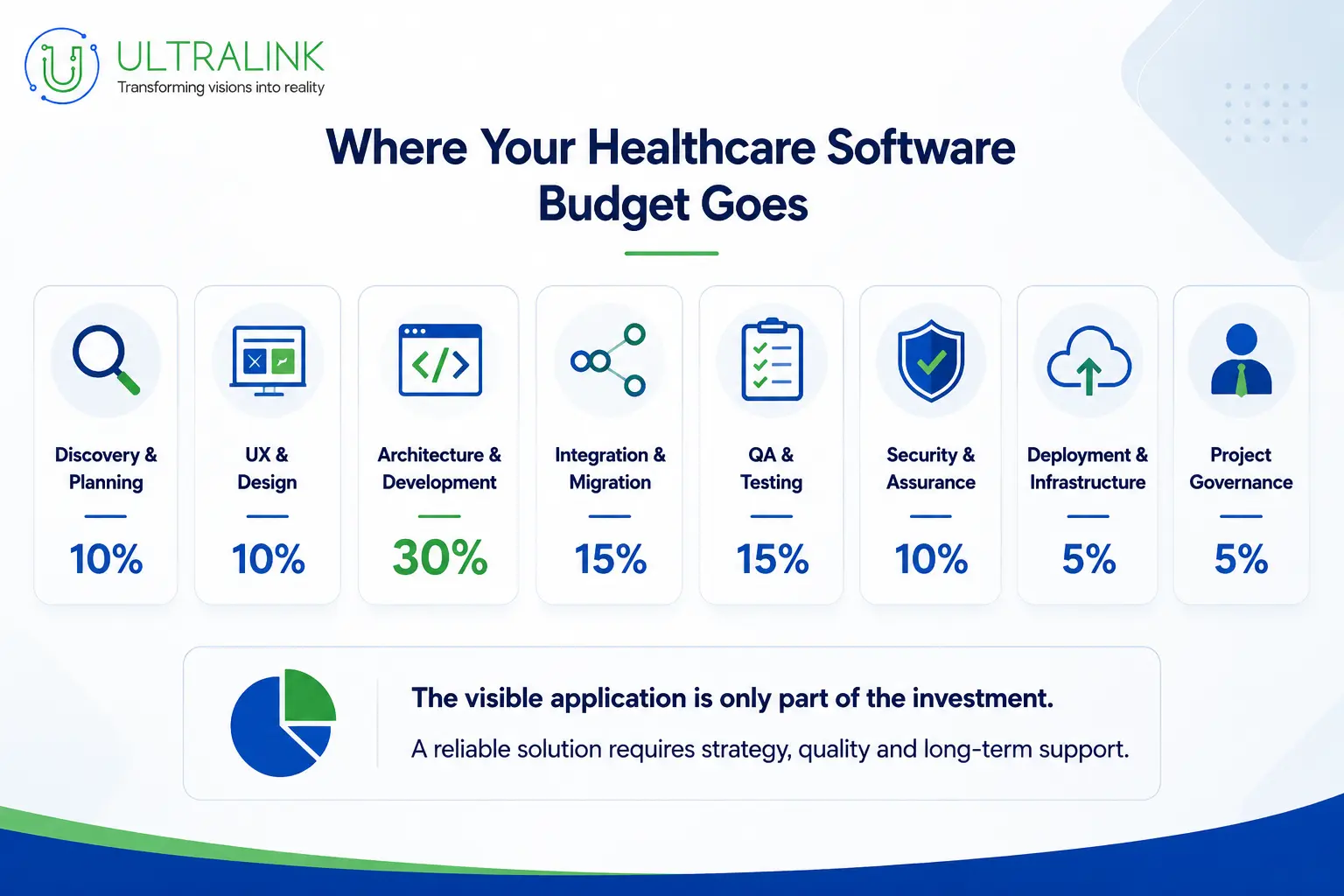
The visible application is only one part of the project. A realistic budget may cover the following activities.
Discovery and Requirements
The team maps current workflows, user needs, system dependencies, risks and project objectives. Discovery helps reduce uncertainty before a full delivery commitment is made.
UX and Service Design
Design work covers more than colours and layouts. It defines how patients, clinicians and employees complete tasks, understand information, recover from errors and move between digital and human support.
Architecture and Engineering
This includes the application, databases, business rules, permissions, APIs, logging, infrastructure and other technical components required to operate the software.
Integration and Data Migration
The team connects external systems, maps information, handles failures and validates that data remains complete and accurate. Historical information may also need to be assessed, cleaned and migrated.
Quality Assurance
Testing can cover workflows, permissions, devices, browsers, integrations and failure scenarios. Projects may also require accessibility, performance and security testing.
Security and Assurance
Security architecture, risk assessments, technical documentation, penetration testing and responses to customer assurance questions may all require dedicated effort.
Deployment and Adoption
Launching the software may involve configuration, user migration, training, support materials and a controlled rollout across departments or locations.
Project Governance
Healthcare projects often involve operational, technical, clinical, data-protection and procurement stakeholders. Effective governance helps manage decisions, risks and dependencies throughout delivery.
A lower initial estimate may exclude several of these activities. Buyers should therefore compare what each proposal includes, rather than comparing only the headline price.
Consider the First Release and the Long-Term Cost of Ownership
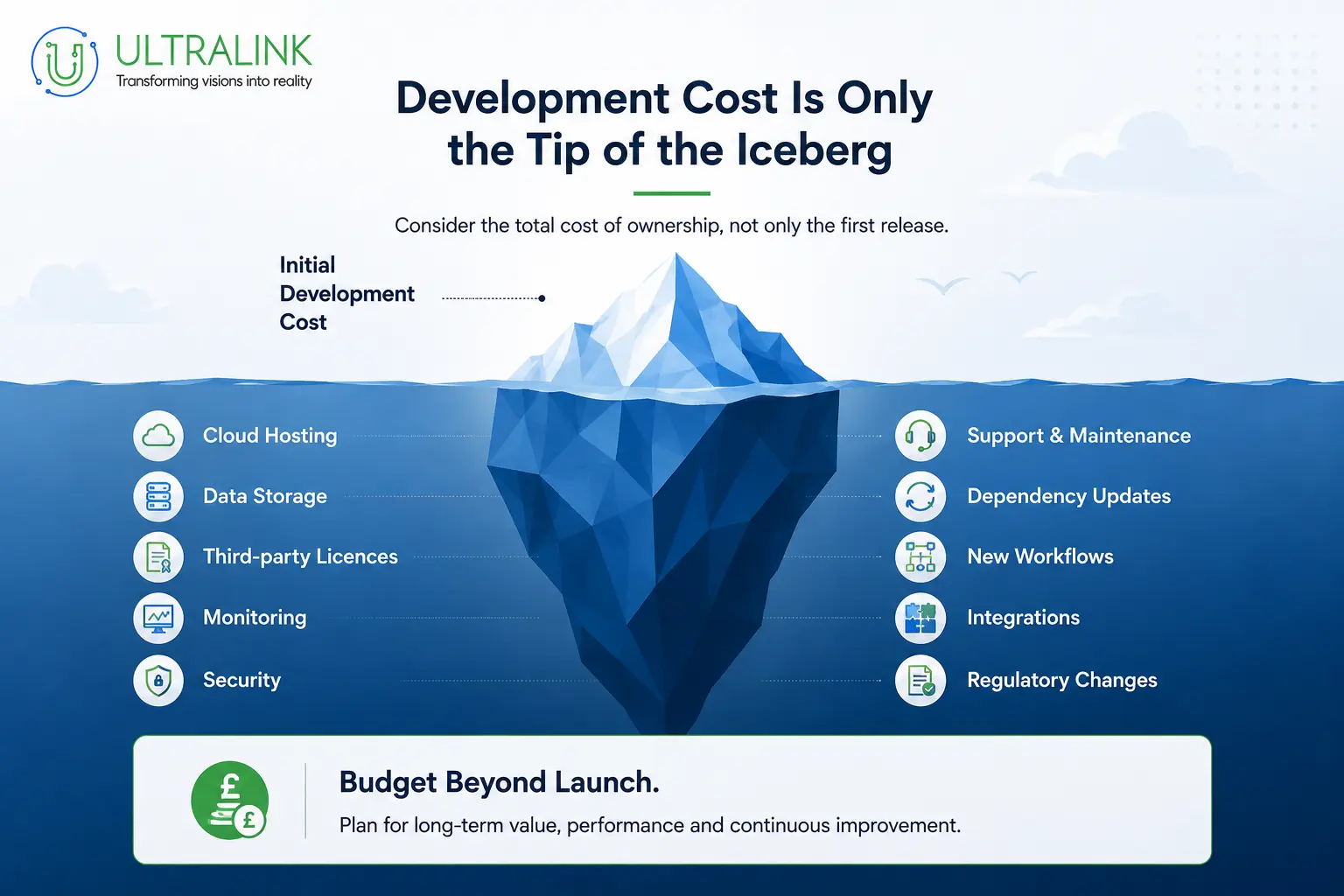
The initial development estimate is only one part of the total investment required to operate healthcare software.
A complete cost assessment should consider:
- Discovery and requirements planning
- Software design and development
- System integrations
- Data migration
- Testing and security assurance
- Cloud hosting and data storage
- Third-party APIs and software licences
- Monitoring, backups and incident response
- User onboarding and training
- Ongoing technical support
- Compatibility and dependency updates
- Future workflows, reports and integrations
- Changes required by organisational or regulatory developments
Post-launch requirements vary considerably. A focused internal application supported during business hours will have different operational needs from a critical platform requiring continuous monitoring, rapid incident response and regular product development.
Prospective development partners should clearly separate:
- What is included in the initial delivery
- Which services create recurring costs
- Which third-party charges are paid separately
- What level of post-launch support is provided
- How future improvements will be estimated
Reviewing the complete ownership requirements helps the organisation plan beyond launch and reduces the risk of unexpected operational costs.
How to Reduce Cost Without Creating Expensive Problems Later
Reducing the first release to its most valuable scope can help control expenditure. Reducing essential assurance or technical quality can create security, operational and remediation costs later.
Map the Workflow Before Estimating Features
A feature list can hide process gaps and exceptions. Mapping the complete workflow makes it easier to identify what the software must do and where human decisions should remain.
Separate Essential Outcomes from Desirable Functionality
Prioritise the smallest set of capabilities that can solve the main operational problem. Additional dashboards, automation and secondary user groups can be considered for later releases.
Investigate Integrations During Discovery
Confirm API availability, data formats, access arrangements, vendor costs and technical limitations before agreeing to the delivery budget.
Confirm the Assurance Route Early
Identify potential clinical safety, DTAC, data-protection, accessibility and regulatory requirements before architecture and development decisions become expensive to change.
Reuse Existing Platforms Where They Genuinely Fit
Microsoft Power Platform, Dynamics 365 and established cloud services may reduce the custom engineering required for some operational applications. However, licensing, scalability, usability and technical limitations must be assessed before selecting a platform.
Design for Later Phases Without Building Them Immediately
The architecture should accommodate realistic future requirements, but the first release should not contain speculative functionality that has not been validated.
Reduce Scope, Not Essential Protection
Testing, security and data governance should not be treated as optional extras. If the available budget is too low, consider reducing workflows, user groups or integrations rather than weakening the safeguards needed for the remaining scope.
Custom Development or an Existing Platform: Which Costs Less?
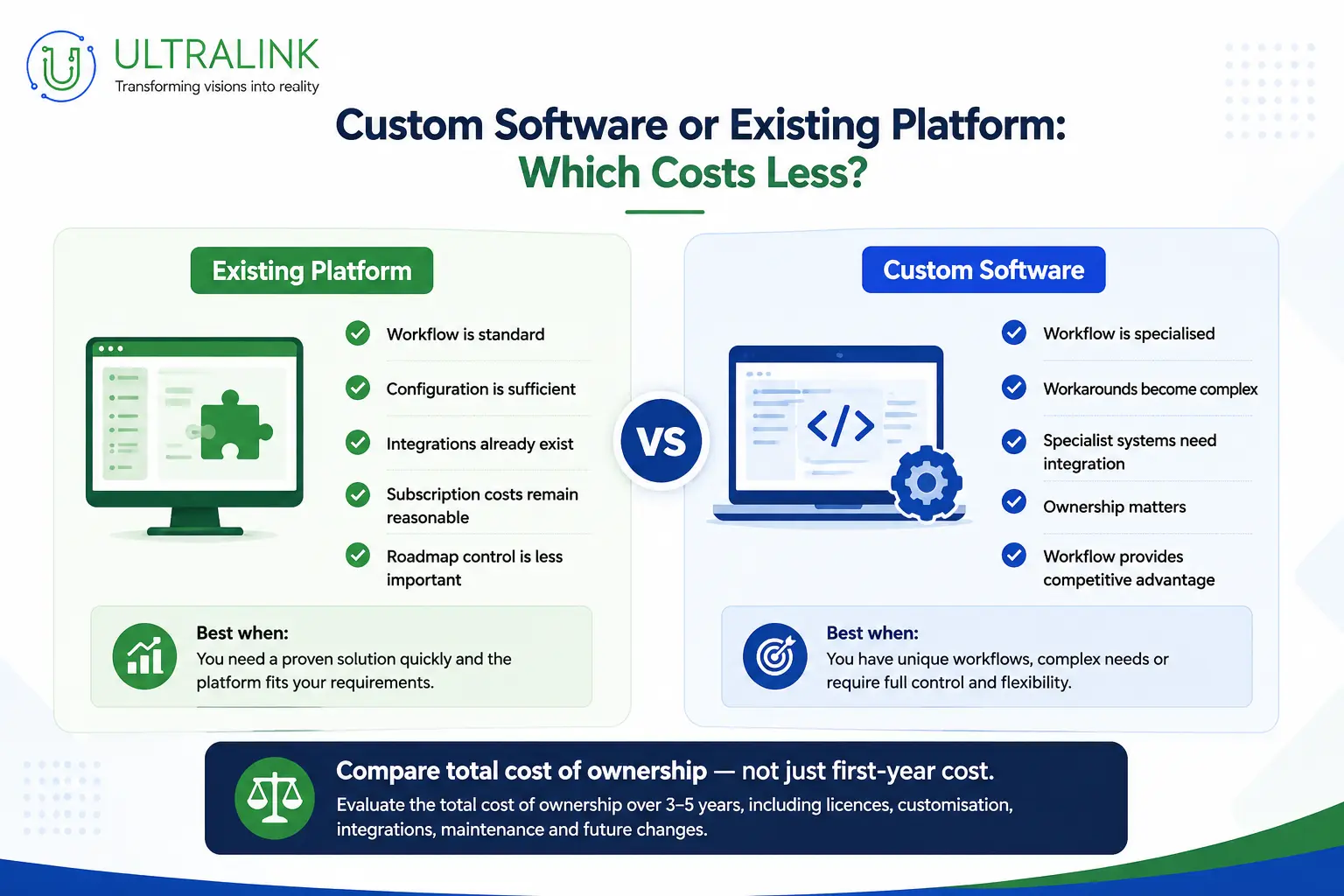
Custom development is not automatically the best or most economical option. Some organisations can achieve their objectives through an existing healthcare product or configurable business platform.
| An existing platform may cost less when… | Custom software may offer better value when… |
|---|---|
| The required workflow is relatively standard | The workflow provides a meaningful operational advantage |
| Configuration meets most requirements | Extensive workarounds would otherwise be required |
| The necessary integrations already exist | Specialist or legacy systems must be connected |
| Subscription costs remain proportionate | Licence costs increase significantly as usage grows |
| Limited control over the roadmap is acceptable | Ownership and roadmap control are commercially important |
| The organisation can adapt its process | The technology must support an established specialist process |
The comparison should consider licensing, configuration, integration, support and switching costs over an appropriate period. A lower first-year price does not necessarily produce a lower total cost of ownership.
What We Need to Produce a Reliable Project Estimate
A development company can provide a more dependable estimate when the buyer can explain:
- The operational problem being addressed
- The intended users
- The organisations and locations involved
- The essential first-release workflow
- Existing systems that must be connected
- The information the software will process
- Whether it may influence clinical decisions
- Whether it will be used by private providers, NHS organisations or both
- Expected user and transaction volumes
- The target launch date
- The available budget range
- The stakeholders involved in approval
You do not need to arrive with a completed technical specification. A structured discovery exercise can turn operational requirements into an appropriate first-release scope, architecture and delivery plan.
Being transparent about the available budget also helps the development team recommend a realistic route. It is more useful to design the strongest appropriate solution within a known constraint than to scope a platform the organisation cannot approve.
Planning a Healthcare Software Project? Let’s Define the Right Next Step
Whether you are replacing a manual process, connecting disconnected healthcare systems or developing a new digital product, the right starting point is a clear understanding of your requirements.
Tell us what the software needs to achieve, who will use it and which systems it must connect with. Ultralink’s healthcare software team will review your requirements and help you understand the appropriate scope, delivery approach and likely investment.
Note: This article provides general information and does not constitute legal, clinical-safety or regulatory advice. Requirements should be confirmed for the specific product and deployment.