

If you're involved in healthcare operations, this situation may sound familiar.
A patient calls to ask about a previous appointment.
Your team knows the information exists somewhere.
The problem is finding it.
Part of the communication history is stored in an email thread. Appointment details sit in another system. Follow-up notes may be tracked in a spreadsheet. Reporting data comes from somewhere else entirely.
Nothing is technically missing.
Yet staff still spend valuable time searching for information instead of acting on it.
And when this happens dozens of times each day, the impact quickly becomes difficult to ignore.
Many healthcare organisations across the UK face similar challenges. The issue is rarely a lack of effort from staff. More often, systems, processes, and teams have evolved separately over time, making it difficult to maintain visibility across patient communication, appointments, follow-ups, reporting, and operational activities.
As healthcare organisations continue investing in digital transformation, improving workflow visibility has become a growing priority.
This article explores why disconnected healthcare workflows occur, the operational challenges they create, and how Microsoft Dynamics 365 Solutions can help organisations create a more connected way of working.
Key Takeaways
- Disconnected systems often create communication gaps, reporting challenges, and unnecessary administrative work.
- Limited visibility can make it harder for teams to coordinate patient communication and operational activities.
- Microsoft Dynamics 365 helps centralise communication, workflow management, reporting, and operational processes.
- Connected workflows support better information accessibility across departments.
- Successful healthcare CRM projects focus on operational requirements before technology.
What Are Disconnected Healthcare Workflows?
Disconnected healthcare workflows occur when patient communication, appointments, referrals, reporting, and operational processes are managed across systems that do not effectively share information.
Most organisations do not intentionally create disconnected workflows.
They usually develop gradually.
A spreadsheet is introduced to manage follow-ups.
A shared inbox is used for patient enquiries.
Appointments are managed in a separate application.
Reporting is generated from another platform.
Each process may work individually, but together they often create information gaps that make day-to-day operations more difficult.
For many healthcare organisations, the challenge is not collecting information.
The challenge is accessing the right information quickly when it is needed.
Why Disconnected Workflows Become a Problem
At first, disconnected systems may not seem like a major issue.
Teams adapt.
Processes evolve.
Workarounds are created.
However, as organisations grow, these small inefficiencies often become more noticeable.
Common challenges include:
- Inconsistent patient communication
- Difficulty tracking appointments and follow-ups
- Delays in finding information
- Duplicate administrative work
- Limited reporting visibility
- Reduced coordination between departments
- Increased reliance on manual processes
Over time, these issues can create operational friction that affects both staff efficiency and organisational visibility.
The Hidden Cost Is Not the Software
Many healthcare organisations assume the problem is technology.
In reality, the biggest cost is often time.
Time spent searching for information.
Time spent manually updating records.
Time spent chasing follow-ups.
Time spent producing reports from multiple systems.
Individually, these delays may seem small.
Collectively, they can create a significant administrative burden across the organisation.
In many cases, teams become so accustomed to these inefficiencies that they no longer recognise how much time is being lost.
The Impact on Day-to-Day Healthcare Operations
Disconnected workflows affect more than administration.
They affect how teams communicate and work together.
For example, if a patient speaks with one department and later contacts another, staff may not have access to the same information.
If follow-up activities are managed manually, tasks can be delayed or missed.
If reporting data sits across multiple systems, managers may spend more time collecting information than analysing it.
These challenges often place additional pressure on teams already managing patient communication, referrals, appointments, and operational responsibilities.
As healthcare services continue to evolve, improving information accessibility has become increasingly important for organisations looking to improve operational efficiency.
Expert Insight
One of the most common assumptions we see is that organisations need more software.
In many cases, they already have the technology they need.
The challenge is that systems have often been implemented at different times for different purposes, making it difficult to maintain visibility across day-to-day healthcare operations.
Improving visibility is often one of the fastest ways to reduce administrative friction and improve workflow efficiency.
A Practical Example
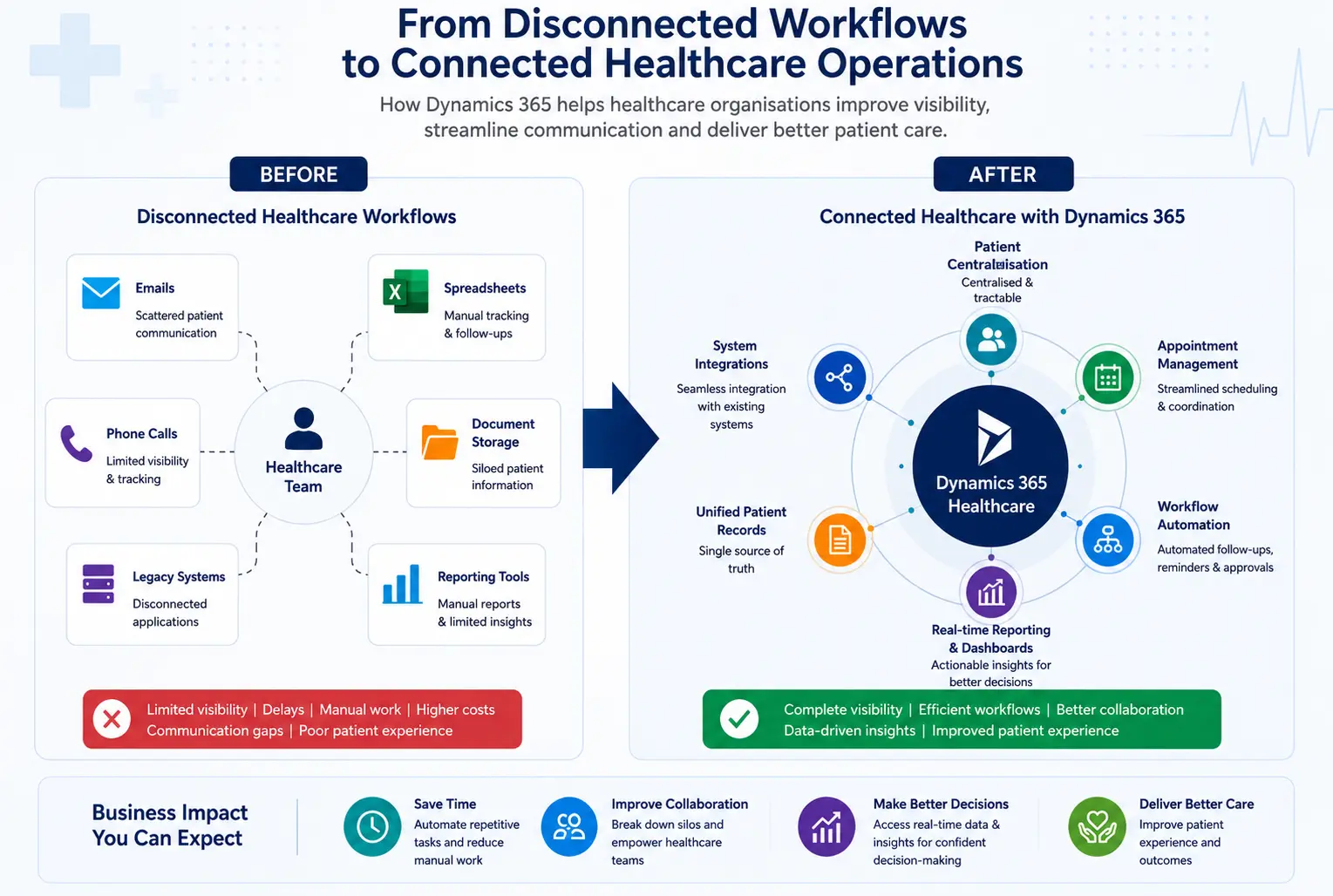
Imagine a healthcare provider managing referrals, appointments, patient communication, and reporting across several departments.
One team uses spreadsheets.
Another relies on email.
Appointment information is stored in a separate platform.
Reporting data comes from multiple sources.
When staff need a complete view of a patient interaction, they may have to search several different locations before finding the information they need.
The information exists.
The challenge is accessing it efficiently.
This is where connected healthcare systems can make a significant difference.
Why Healthcare Organisations Are Reviewing Workflow Visibility
Across the UK, healthcare organisations are reviewing how information flows between teams, systems, and departments.
As operational demands continue to increase, organisations are looking for ways to improve visibility, reduce administrative complexity, and create more connected processes.
Many organisations are also exploring Microsoft Cloud for Healthcare technologies to support connected services, information accessibility, and long-term digital transformation initiatives.
The goal is not simply to introduce new technology.
The goal is to make existing processes easier to manage.
How Microsoft Dynamics 365 Helps
Microsoft Dynamics 365 helps healthcare organisations create a more connected operational environment through a dedicated Dynamics 365 Healthcare solution designed to improve patient communication, workflow visibility, reporting, and operational coordination.
Rather than managing communication, workflows, reporting, and operational processes across multiple disconnected systems, teams can work from a platform that provides greater visibility and accessibility.
Healthcare organisations commonly use Dynamics 365 to:
- Manage patient communication
- Track appointments and follow-ups
- Improve workflow visibility
- Support reporting requirements
- Connect healthcare systems
- Reduce manual administration
- Improve collaboration between departments
- Support workflow automation
The objective is not necessarily to replace every existing system.
The objective is to create a connected environment where information can move more efficiently across the organisation.
Looking to Improve Workflow Visibility?
If your organisation currently manages communication, appointments, follow-ups, and reporting across multiple systems, it may be worth reviewing how those processes work together.
A connected healthcare CRM platform can often reveal opportunities to reduce manual work, improve reporting visibility, and support more efficient operational processes.
Traditional Processes vs Connected Workflows
| Traditional Approach | Connected Dynamics 365 Approach |
|---|---|
| Information stored across multiple systems | Centralised visibility |
| Manual follow-up tracking | Structured workflow management |
| Separate communication records | Connected communication history |
| Manual reporting processes | Improved reporting visibility |
| Disconnected departments | Better coordination across teams |
| Repetitive administrative tasks | Workflow automation support |
A Common Mistake Healthcare Organisations Make
Many organisations focus on selecting software before understanding the workflow challenges they are trying to solve.
Successful projects often begin with a simpler question:
"Where are we losing visibility?"
Once teams understand where information becomes difficult to access, where delays occur, and where manual work consumes time, identifying improvements becomes much easier.
Technology should support operational processes rather than adding additional complexity.
What to Review Before Introducing a New System
Before implementing a healthcare CRM or workflow management platform, it is worth reviewing:
- How patient communication is managed
- How appointments are tracked
- How follow-ups are recorded
- Which reports require the most manual effort
- Which systems need to share information
- Where staff spend the most time on administration
- Which workflows create bottlenecks
- Where visibility is currently limited
This often provides a clearer understanding of where operational improvements can be made.
How Ultralink IT Supports Healthcare Organisations
At Ultralink IT, we help healthcare organisations across the UK improve workflow visibility, patient communication, reporting, and operational coordination through Microsoft Dynamics 365.
Our services include:
- Dynamics 365 Implementation
- Healthcare CRM Solutions
- Patient Communication Workflows
- Workflow Automation
- Healthcare System Integration
- Customisation and Development
- Ongoing Support and Optimisation
Our focus is on delivering practical solutions that support day-to-day healthcare operations rather than adding unnecessary complexity.
Ready to Improve Operational Visibility?
Many healthcare organisations already have the information they need.
The challenge is knowing where workflows become disconnected and where teams lose visibility.
If your organisation is reviewing communication processes, workflow management, reporting, or healthcare system integration, it may be worth taking a closer look at how information currently moves across your operations.
Microsoft Dynamics 365 can help create a more connected environment for patient communication, workflow management, reporting, and operational coordination.